
Patent No. 10-1550308Trademark Reg. 40-1634245US FDA Registered Reg. 3017191571WHO Class A1 ingredient99.999% kill*Color-free & odorlessMade in Korea
Sanitizer for food-contact surfaces

A sanitizer for every surface that touches food

A chlorine dioxide sanitizer for food-contact utensils, containers and packaging surfaces. Color-free and odorless, WHO Class A1 rated ingredient, effective at 1 ppm (test-data basis), ready to use with no dilution.

2 yrs+
98% active retention
pH 2–10
Effective across wide pH
×5
Kill power vs. bleach
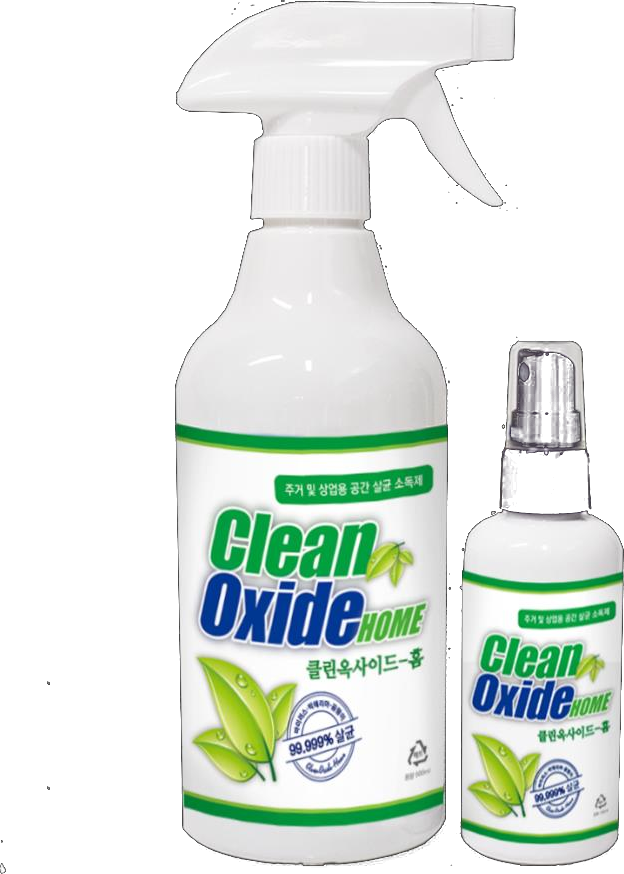
CleanOxide Spray 500ml and portable mist product photo
  • No carcinogenic by-products (THMs·HAAs)
  • Breaks down into salt after use
  • No VOCs · 100% biodegradable
  • Ready to use · no dilution required
  • Color-free · odorless · low irritation
Why CleanOxide

What conventional chlorine dioxide could never do

Ordinary chlorine dioxide water evaporates within a month and smells strong. CleanOxide changes this fundamentally with a nano-emulsion coating.

2+ year shelf life

Retains 98% of its active ingredient for over 2 years under normal storage — unlike conventional ClO₂ water that evaporates within a month.

Color-free & odorless

In its emulsion-coated state it has no color or odor, so it is unobtrusive next to ingredients and during food preparation.

Sterilization-check technology

It reacts only when the emulsion breaks upon meeting microbes. Odor = contamination present; no odor = clean. (Core of the patent.)

No equipment corrosion

It oxidizes selectively against microbes only, so no corrosion on stainless worktops, knives or equipment, and no microbial resistance builds up.

ClO₂ vs. sodium hypochlorite (bleach)

Same disinfection — a different mechanism

CleanOxide (chlorine dioxide)

  • Maintains kill power across a wide pH range (2–10)
  • About 5× the kill power of bleach
  • No carcinogenic by-products (THMs·HAAs), no VOCs
  • No corrosion of utensils or equipment metal, no microbial resistance
  • Kills E. coli at just 1 ppm (test-data basis)

Ordinary bleach (sodium hypochlorite)

  • Effective only under alkaline conditions; pH-dependent
  • Strong chlorine odor
  • Risk of carcinogenic by-products (THMs)
  • Can corrode metal and cause discoloration
  • Needs 10 ppm to kill E. coli (10× CleanOxide)
Signature Data

Concentration needed to kill E. coli

Comparison of the concentration required to kill E. coli under identical conditions (2 min 30 s). Lower means less product is needed. (Log scale.)

CleanOxideChlorine dioxide
1 ppm
BleachSodium hypochlorite
10 ppm
PovidoneIodine
10 ppm
EthanolAlcohol
500,000 ppm
Bar length = log₁₀ scale · values are measured concentrations

※ Figures on a test-data basis. Per-strain concentrations for foodborne-related organisms are documented (e.g. S. aureus at 1 ppm); see the Technology page for detailed data.

Our Story

From import to localization — and back to export

STEP 01

Imported the US chlorine dioxide solution

Officially imported the US chlorine dioxide disinfection solution, gaining market and technical experience.

STEP 02

Developed a proprietary nano-emulsion process

Through localization research we developed a nano-emulsion stabilization technology that solved shelf-life, odor and evaporation.

STEP 03

Patent granted · CleanOxide launched

Registered the patent for a 'disinfectant whose degree of sterilization can be verified' (No. 10-1550308) and began domestic production.

STEP 04

US FDA registration

US FDA registration (Reg. 3017191571) secured a foundation for export.

PATENT

Patent No. 10-1550308

Manufacturing method for a disinfectant whose degree of sterilization can be verified, and the resulting disinfectant.

®

Trademark Reg. 40-1634245

Class 5 · designated goods incl. disinfectants and sanitizers (registered 2020-08-17).

FDA

US FDA Registered

Classified as Disinfectant / Medical Devices · Reg. No. 3017191571

WHO
A1

WHO Class A1 ingredient

The WHO classifies chlorine dioxide as A1 — the highest safety grade among food additives.

FAQ

Frequently asked questions

How is it different from bleach?
Chlorine dioxide maintains kill power across a wide pH range (2–10), generates no carcinogenic by-products (THMs·HAAs), and causes no metal corrosion of utensils or equipment. It kills E. coli at just 1 ppm (test-data basis).
Is it really odorless? Is odor a defect?
In its emulsion-coated state it is color-free and odorless. Odor appears when the emulsion breaks and reacts upon meeting microbes — a signal that contamination was present. No odor means clean. (This is the core of the patent.)
Where and how is it used?
This product is a sanitizer for food-contact utensils, containers and packaging surfaces. Spray onto surfaces such as cutting boards, knives and worktops and wipe off or let air-dry; follow the usage instructions on the product label for details.
How should it be stored?
Stored away from direct sunlight in a cool place, it retains 98% of its active ingredient for over 2 years.

Considering adoption for your business?

Tell us your industry and usage scale and we'll prepare a tailored quote.